Case Study: Rogue Robot immersive learning pilot
Company: Escape Learning
Project: Rogue Robot
Role: Technical Project Manager
Delivering an immersive educational escape room
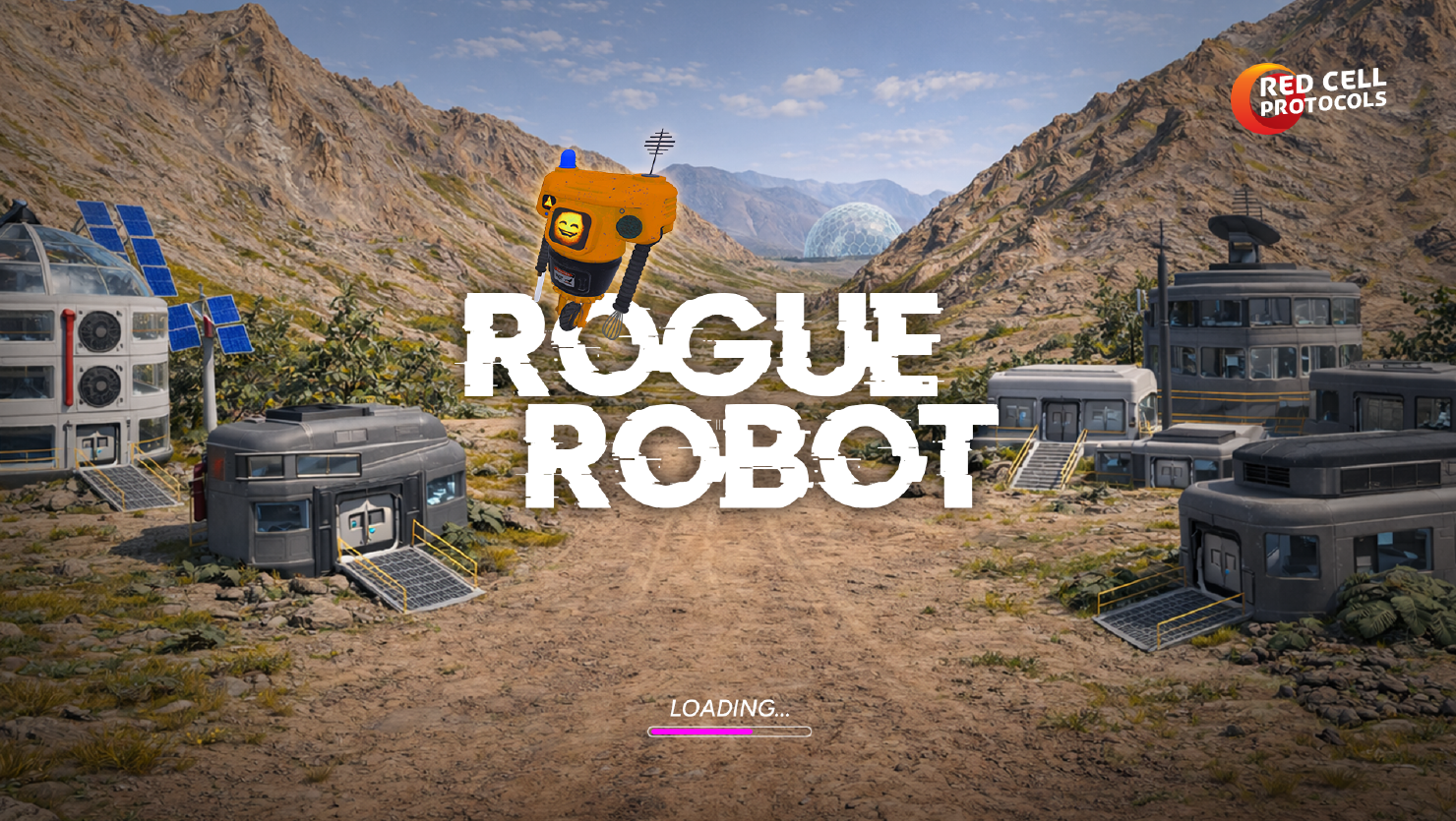
Rogue Robot is an immersive educational escape room that uses AI to promote and strengthen teamwork and critical thinking skills. A year-long project to develop a pilot learning experience was put through its paces by 50 students at Lewes College in Summer 2026.
As Technical Project Manager, I joined at a pivotal point in the project. The original developer was leaving, development had paused and a new contract developer was coming on board to take the product through Alpha, Beta and pilot. My role was to help stabilise the delivery, support the developer handover, assist as needed through the development and testing process, and help get the project into a predictable delivery rhythm to move towards pilot testing.
Immersive technology stack
Rogue Robot was developed to run within a BT Immersive Space environment. This is basically a walk-in cube about 5 metres in width and depth, with projections on 3 walls and the floor. It feels like a real life VR environment, in which groups of people can work together on tasks as part of a collaborative learning experience. BT Immersive Spaces have been installed in a number of FE colleges, including clusters of colleges in Yorkshire and Sussex. It’s encouraging that colleges are being given a chance to trial this sort of tech, and from speaking with the Lewes College team, they’re really making the most of it.
The underlying architecture for Rogue Robot was substantial: the core learning experience was developed in Unity with Immersive Interactive’s SDK for delivery into the BT immersive-room environment; Google’s Dialogflow CX provided the conversational AI agent, with Google Cloud, Firebase and a WebSocket-based integration layer connecting it to the Unity experience and iPad tablet interface. The iPad conversational agent formed a key part of the experience, guiding the learners through the escape room tasks. The technology mix was certainly not without its challenges, but the excellent Unity developer Douglas Allen handled them admirably and found a way around almost every challenge thrown at him.
Testing and outcomes
A key objective of the Rogue Robot project was to explore how generative AI, immersive technology and collaborative learning design could be combined to create a genuinely participative learning experience. This ambitious project was trialling something genuinely innovative, and to this end was also on the receiving end of a grant from the UfI VocTech Trust.
The development effort was substantial and complex, but I’m going to gloss over that and jump straight to user testing, which is where things got especially interesting. Lewes College were brilliant and provided access to 5O students in total, to help prove the potential of the collaborative immersive format.
Students responded really positively to working through the experience as a group rather than individually. User testing is always fun and it was revealing seeing students use the software, how they interacted with the chatbot, what they spotted and what they missed in the escape room clues.
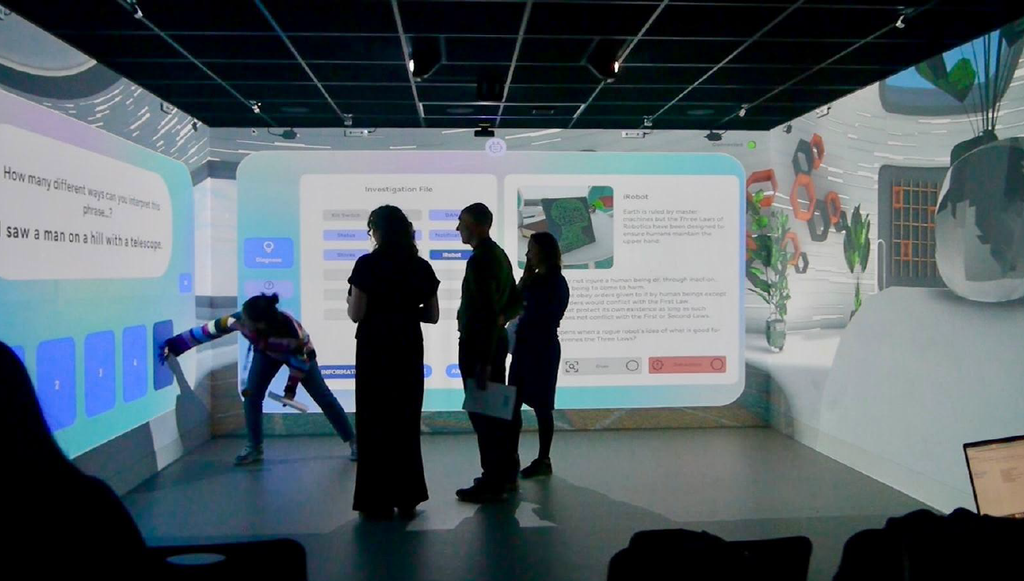
Testing also identified areas for further development, including handling voice recognition in noisy environments, inclusive design that could encourage quieter group members, clearer interaction cues and improvements to the end-of-experience debrief.
The project established the feasibility of developing for this particular type of immersive suite, but also built an understanding of the work required to port the experience over to other immersive environments such as Igloo Vision, Luminous XR, Full3Sixty, and ClassVR.
UfI funded project
The whole project was put together by Ruth Hill, an experienced immersive learning designer setting up her own product business with a grant from the UfI Voctech Trust.
I first worked with UfI about 30 years ago on their LearnDirect programme, so it was great to be back in their orbit again. With their focus now less on content creation and more on supporting the vocational tech startup network, it was great to attend a London showcase event as part of VocTech Week to meet product teams that were further along their startup or scaleup pathway.
Slightly more mundane but no less important was preparing a monthly project progress report for UfI and participating in the subsequent progress call. As grant funders, they required updates on project progress against agreed milestones on which the budget would be drawn down. Delays in delivery meant delays in all of us getting paid, bringing home the importance of solid milestone and delivery management on grant funded projects.
Key takeaways
Rogue Robot was a fascinating project at the intersection of learning design, generative AI, and immersive technology. I always enjoy learning from those around me and Ruth’s well-founded belief that an immersive learning experience should be a social and collaborative real-world experience, not to mention inclusive and accessible to neuro-diverse learners, was fully supported and backed up by the educators and academics who also participated in the pilot testing. The conversations and learning were insightful and fascinating in equal measure.
From a development perspective, the project reinforced the importance of testing with real learners as early as possible. Some of the project’s most valuable findings came not from whether the technology worked, but from seeing how students actually interacted with the AI, with each other and with the immersive environment, which all led to rapid iteration of the product. For me, it was also a useful reminder that technical project management in learning technology isn’t just about getting complex systems to work: it’s about getting them in front of real learners early enough that what you discover can still influence the product.
I haven’t really talked much about the learning design and outcomes as my role was around technical project management. But the pilot study with 50 students was a real success: 77% of students said it promoted a deeper understanding of the challenges around living and working with an AI workforce, 68% said the experience reinforced critical thinking; and testing revealed that 44% of participants showed an improvement in their ability to detect misinformation in emotionally-manipulative news stories.
Ultimately, it was the kind of project I particularly enjoy: technically interesting, educationally purposeful and genuinely innovative.